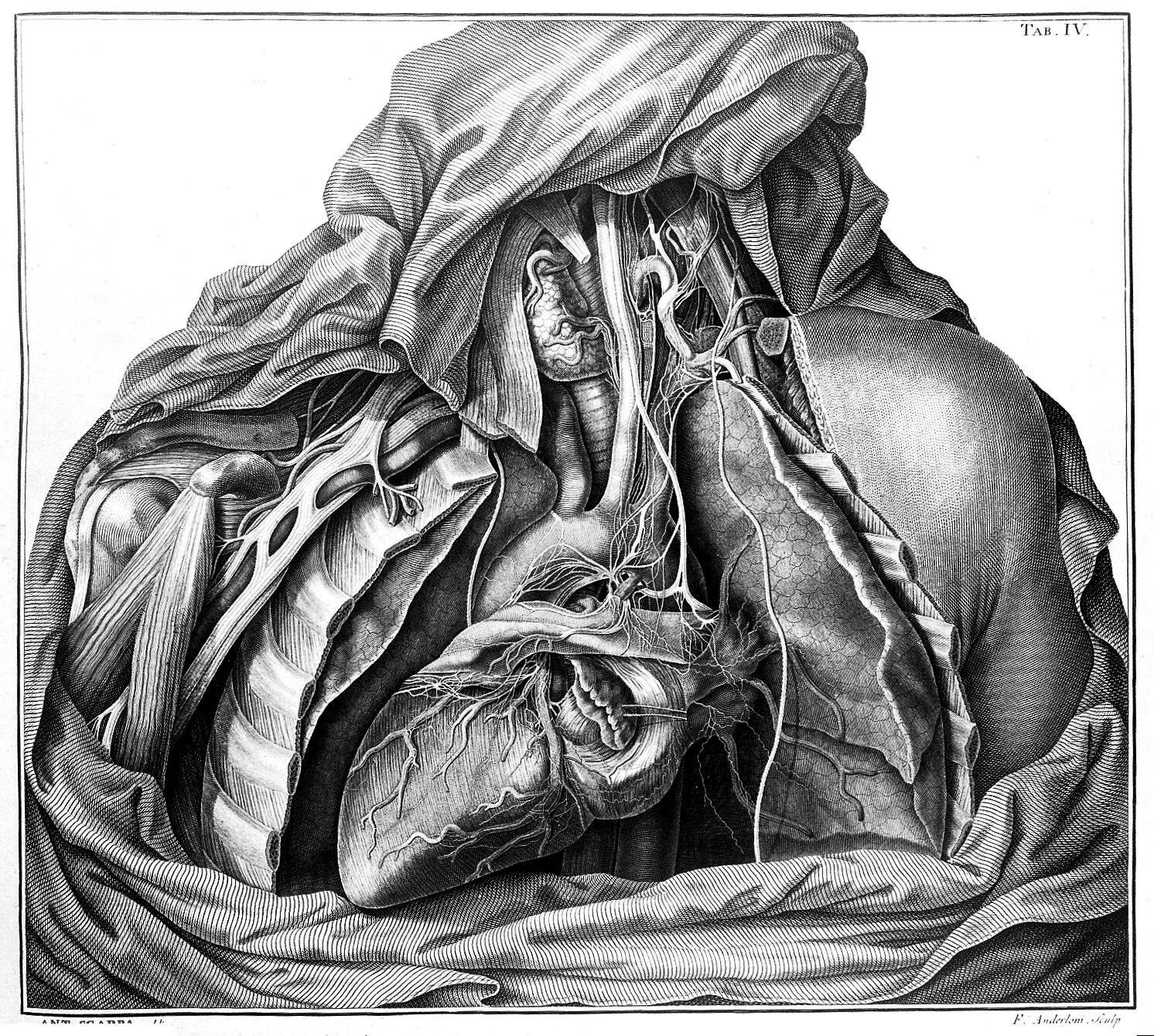
Credit: Tabulae nevrologicae ad illustrandam historiam anatomicam cardiacorum nervorum, noni nervorum cerebri, glossopharyngaei, et pharyngaei ex octavo cerebri / Auctore Antonio Scarpa. Source: Wellcome Collection.
The Biology of Liberation is the cellular and neurological process of moving from chronic threat prediction to flexible, present-moment regulation (Nardone, 2026).
What has to change in the body—not just the mind—in order to feel free?
Women arrive at midlife having done serious work on themselves. They have language for what they’re carrying. Something still isn’t moving. The mind got the message. The body hasn’t.
The 5 Domains
The Biology of Liberation operates across five interconnected systems.
Co-Regulation
The nervous system cannot shift out of chronic activation alone. In the presence of another human whose own system is settled, it begins to move. This is co-regulation (Porges, 2011).
Narrative Reclamation
The nervous system predicts based on the stories it has learned to tell. Narrative approaches to trauma work by interrupting predictions and building new ones from the ground of lived experience (White & Epston, 1990; Schauer et al., 2011). Changing the story requires the nervous system to experience something different.
Nervous System Flexibility
The brain predicts based on experience and updates those predictions against new information. Trauma disrupts this. The nervous system learned to brace and keeps bracing after the threat has passed. Liberation is the restoration of that flexibility: the capacity to update and stop predicting danger as the default (Friston, 2010; Kotler et al., 2025).
Nutritional Ground
What we eat shapes regulation: gut-brain communication, inflammation, and neurotransmitter production. The gut produces about 90% of the body’s serotonin. Dietary patterns directly predict psychological outcomes independent of other variables. Food is the ground under everything else (Cryan & Dinan, 2012; Jacka et al., 2017).
Somatic Attunement
Chronic stress and trauma dysregulate interoception—the body’s ability to perceive its own internal state (Craig, 2003; Seth, 2021). Somatic attunement is the restoration of that perception: learning to read and trust what the body is saying.
Common traits of women reaching for the Biology of Liberation.
A knowing the system has repeatedly told them to doubt
A body that registers what the mind hasn’t named yet
Decades of performing capably and fine—and the exhaustion underneath it
A perimenopause or midlife shift that feels less like a crisis and more like an exposure: the scaffolding coming down, something older surfacing beneath it
Grief set down somewhere along the way and never picked back up
Serious inner work already done: therapy, self-development, real language for what they carry, and something is still not moving
The particular exhaustion of being a woman who knows something, gets dismissed for knowing it, and turns out to be right
A nervous system that has forgotten what safe feels like
The experience of being witnessed as insufficient: fixed, managed, or looked away from
A hunger for movement, not more insight
Term History
In the Spring of 2026, I coined the term the Biology of Liberation during clinical training in grief, loss, and end-of-life care in a hospital setting and private practice work with women at midlife.
The question began nineteen years ago when my son Isaiah was persistently sick and every doctor said he was fine. I knew something was wrong before I could argue it. The body knew—mine knew he was sick when the system said otherwise, and the answer was in what he was eating. That experience—of being a woman who knows something, gets dismissed for knowing it, and turns out to be right—is where the thread began.
I’ve followed it for nearly twenty years. My own nervous system spent years in chronic threat, and the path back was not insight. Understanding came first. The body took longer. What changed it was food, somatic work, being in the presence of people who weren’t bracing, and time—a hundred quiet shifts until the baseline changed.
The Biology of Liberation is what I've been building toward. It just took this long to have a name.
References
Cryan, J.F. & Dinan, T.G. (2012). Mind-altering microorganisms: the impact of the gut microbiota on brain and behaviour. Nature Reviews Neuroscience, 13(10), 701–712.
Craig, A.D. (2003). Interoception: the sense of the physiological condition of the body. Current Opinion in Neurobiology, 13(4), 500–505.
Friston, K. (2010). The free-energy principle: a unified brain theory? Nature Reviews Neuroscience, 11(2), 127–138.
Jacka, F.N. et al. (2017). A randomised controlled trial of dietary improvement for adults with major depression (the 'SMILES' trial). BMC Medicine, 15(1), 23.
Kotler, S., Mannino, M., Friston, K., Buzsáki, G., Scott Kelso, J.A., & Dumas, G. (2025). Pathfinding: a neurodynamical account of intuition. Communications Biology, 8, 1214.
Porges, S.W. (2011). The Polyvagal Theory: Neurophysiological Foundations of Emotions, Attachment, Communication, and Self-Regulation. Norton.
Schauer, M., Neuner, F. & Elbert, T. (2011). Narrative Exposure Therapy: A Short-Term Treatment for Traumatic Stress Disorders. Hogrefe
Seth, A. (2021). Being You: A New Science of Consciousness. Dutton.
White, M. & Epston, D. (1990). Narrative Means to Therapeutic Ends. Norton.